
Reserve Fund Report vs. Reserve Fund Plan—What's the Difference (Alberta Condo Board Guide)
Updated: Apr 11
Need a Reserve Fund Study in Edmonton?
Brookstone is an engineering firm and reserve fund study provider with in-house APEGA-licensed Professional Engineers (P.Eng.). Request a Reserve Fund Study Quote (Edmonton)
If you're a condominium board member in Alberta, you've likely encountered the terms "reserve fund report" and "reserve fund plan"—perhaps used interchangeably in conversations, emails, or board meetings. A reserve fund report is the comprehensive engineering study that evaluates your property's assets and projects future capital expenses, while a reserve fund plan is the board-adopted financial strategy that dictates how much to collect annually to fund those repairs and replacements. Understanding this distinction isn't just semantic—it's the difference between receiving professional recommendations and actually implementing a compliant, financially sound roadmap that protects your condominium corporation from special assessments and underfunding.

What Is a Reserve Fund Report? (Legal Definition for Alberta Condos)
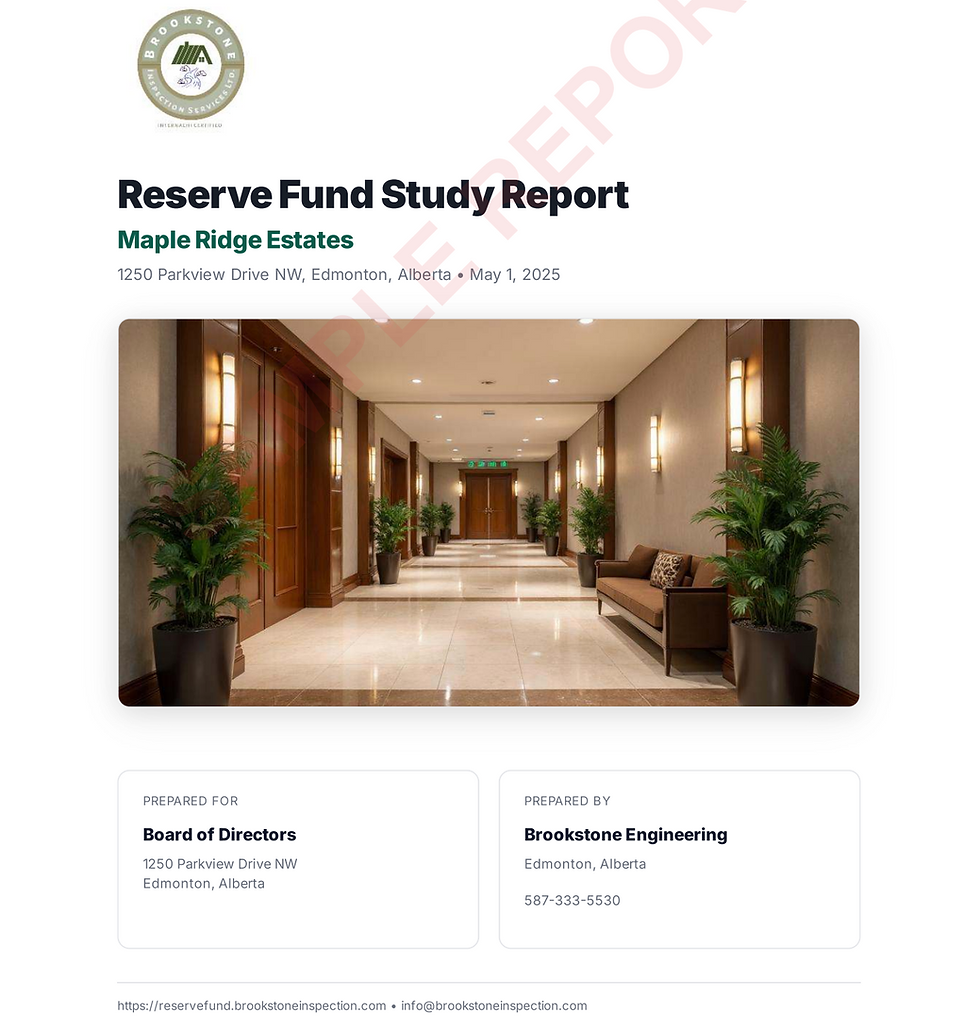
A reserve fund report—often called a reserve fund study—is a comprehensive assessment report prepared by or under the supervision of a Professional Engineer licensed in Alberta. This document serves as the technical foundation for your condominium corporation's long-term capital planning.
Components of a Reserve Fund Report
According to Alberta's Condominium Property Regulation, a complete reserve fund report must include:
Physical Site Inspection: A P.Eng. or qualified technologist conducts an on-site assessment of all common property components, from roofing and building envelope to mechanical systems and paving
Component Inventory: A detailed catalogue of every asset under the corporation's responsibility, including age, condition, expected lifespan, and replacement cost
Capital Expenditure Forecast: A 30-year projection of when each component will require major repair or replacement, with cost estimates adjusted for inflation
Current Reserve Fund Status: An analysis of existing reserve balances and how they align with projected needs
Funding Recommendations: Professional guidance on contribution levels needed to maintain adequate reserves without triggering special assessments
Executive Summary: A condensed overview designed for board members and owners who need the key findings without technical details
Who Prepares a Reserve Fund Report in Alberta?
Under Alberta law, reserve fund reports must be prepared by or under the direct supervision of a qualified professional, such as a Professional Engineer (P.Eng.) registered with the Association of Professional Engineers and Geoscientists of Alberta (APEGA). This licensing requirement ensures that:
Engineering calculations meet provincial standards
Condition assessments are technically sound
Cost projections reflect industry best practices
The report can withstand regulatory scrutiny and legal challenges
When you engage Reserve Fund Study services in Alberta, you're ensuring your report meets these professional standards and provides legally defensible recommendations.
Legal Requirements for Reserve Fund Reports
The Condominium Property Act mandates that Alberta condominium corporations obtain a reserve fund report:
Within the two years of registration for new condominiums
At least every five years thereafter
Whenever significant changes occur (major renovations, additions, significant damage events)
This report serves as the legal foundation for your reserve planning, and failure to maintain a current report can result in regulatory non-compliance, owner lawsuits, and lending institution concerns.

What Is a Reserve Fund Plan? (Your Board's Adopted Financial Strategy)
While the reserve fund report is a technical document prepared by engineers, the reserve fund plan is the board's actionable financial strategy that translates those recommendations into concrete decisions about contribution levels, capital project timing, and funding approaches.
Key Elements of a Reserve Fund Plan
A properly structured reserve fund plan includes:
Adopted Contribution Rate: The specific dollar amount or percentage that the board commits to collecting annually from unit owners
Capital Project Schedule: The prioritized timeline for major repairs and replacements based on the report's recommendations
Funding Method Selection: Whether the board adopts full funding, threshold funding, or another approach to reach adequate reserve levels
Special Assessment Strategy: Conditions under which the board would levy special assessments versus adjusting contribution rates
Annual Review Process: How and when the board will revisit the plan to adjust for changing conditions or updated cost projections
The Board's Role in Creating the Plan
After receiving the reserve fund report from your P.Eng., the board must:
Review the report's findings and recommendations with the engineer
Evaluate different funding scenarios and their impact on owner contributions
Hold board discussions and potentially owner meetings to review options
Pass a formal resolution adopting specific contribution levels and funding approach
Communicate the adopted plan to all unit owners
Implement the plan through budget adjustments and capital project execution
Monitor and update the plan annually or as circumstances change
This is where the report becomes a plan—when your board takes professional recommendations and commits to specific actions and contribution levels.
Why the Plan Must Be Formally Adopted
Simply having a reserve fund report sitting in your files doesn't satisfy Alberta's legal requirements or protect your corporation from underfunding. The plan must be:
Documented: Formal board resolutions should record the adopted contribution levels and funding approach
Communicated: Owners must understand what they're paying and why
Implemented: The plan must drive actual budget decisions and capital project execution
Reviewed: Annual revisiting ensures the plan remains aligned with current conditions
Many boards make the mistake of commissioning a reserve fund study in Edmonton or elsewhere in Alberta, filing the report away, and never taking the critical next step of adopting and implementing the recommended plan.
Reserve Fund Report vs. Reserve Fund Plan: Side-by-Side Comparison
Understanding the practical differences helps clarify why both are essential:
Aspect | Reserve Fund Report | Reserve Fund Plan |
Who Creates It | Qualified Persons (QP) like Professional Engineer (P.Eng.) | Condominium Board |
Nature | Technical and financial study | Financial and operational strategy |
Content | Asset inventory, condition assessment, cost projections, funding recommendations | Adopted contribution rates, capital schedule, funding method, implementation steps |
Legal Requirement | Must be prepared by a QP like P.Eng. every 5 years minimum | Must be adopted and implemented by board |
Purpose | Provides data and professional recommendations | Commits the corporation to specific actions |
Format | Formal written report with appendices | Board resolutions, budget documents, communication materials |
Flexibility | Static document until next update | Dynamic—can be adjusted annually as needed |
Accountability | Engineer is professionally liable for accuracy | Board is legally responsible for implementation |
The report gives you the "what" and "when"—what needs to be repaired and when. The plan gives you the "how"—how you'll fund those repairs and execute the work.

Why the Difference Matters for Alberta Condo Boards (Compliance, Budgeting & Risk)
The distinction between report and plan isn't academic—it has real consequences for your condominium corporation's financial health, legal compliance, and property values.
Compliance and Legal Risk
Report without Plan: If your board commissions a Reserve Fund Study in Calgary or another Alberta city but never adopts the recommendations, you've satisfied only half the legal requirement. While you have a current report on file, you lack a documented plan that demonstrates fiscal responsibility. This exposes the board to:
Potential regulatory violations
Owner lawsuits alleging mismanagement
Challenges from lending institutions during unit sales
Personal liability for board members who failed to act on engineer recommendations
Plan without Current Report: If your board continues operating on an outdated plan based on a report from six or more years ago, you're making financial decisions on obsolete data. Alberta's five-year update requirement exists because:
Construction costs fluctuate significantly over time
Component conditions deteriorate in ways that change replacement timelines
New building codes or regulatory requirements emerge
Your existing reserve balance has changed substantially
Budgeting and Owner Impact
The plan directly determines what owners pay each month:
Underfunded Plan: If your board adopts contribution levels below the report's recommendations, you're deferring costs that will eventually require special assessments—potentially thousands of dollars per unit when major work can no longer be delayed
Overfunded Plan: While less common, substantially exceeding recommended contributions may unnecessarily burden owners and affect property marketability
Balanced Plan: Following your P.Eng.'s recommendations typically provides the most sustainable path, spreading costs equitably over time
Proper reserve planning based on a current engineering report is one of the most important factors in maintaining property values and owner satisfaction in Alberta condominiums.
Risk Management
The gap between report and plan represents operational risk:
Deferred Maintenance: Without an implemented plan, critical repairs get postponed until emergency situations force reactive spending at premium prices
Special Assessment Surprises: Owners who don't understand the plan (because one was never clearly adopted) face unexpected large bills when major work becomes unavoidable
Board Turnover: When new board members inherit a report but no documented plan, they must start planning from scratch, often leading to inconsistent decision-making
Insurance and Liability: Insurers and legal counsel increasingly scrutinize reserve adequacy; having a current report without an adopted plan raises red flags
Common Board Mistakes & How to Avoid Them (Alberta-Specific Guidance)
Through working with condominium corporations across Alberta—from Edmonton to Red Deer to Calgary—we've observed several recurring mistakes in how boards handle the report-to-plan transition.

Mistake 1: Treating the Report as "The Plan"
What Happens: The board receives a comprehensive reserve fund report and assumes that having this document means they have a plan. They make no formal decisions about contribution levels or capital priorities.
Why It's Problematic: The report provides options and recommendations, not decisions. Without board action, there's no actual plan—just unimplemented advice.
How to Avoid It: Schedule a dedicated board meeting within 30 days of receiving your report to formally review recommendations, evaluate options, and pass resolutions adopting specific contribution levels and funding approach. Document these decisions in board minutes and communicate them to owners.
Mistake 2: Commissioning a Report but Ignoring Recommendations
What Happens: The board orders a reserve fund study (often to satisfy a legal requirement or lender demand), files the report, but continues setting contributions based on arbitrary numbers or what "feels affordable" rather than engineering recommendations.
Why It's Problematic: This creates the illusion of compliance while perpetuating underfunding. When a major failure occurs and the reserve fund falls short, the board faces liability for ignoring professional advice they paid for.
How to Avoid It: If your board believes the report's recommendations are too aggressive, work with your P.Eng. to model alternative scenarios and understand the trade-offs. Document the rationale for any departure from recommendations. If you need to phase in higher contributions over time, create a documented transition plan.
Mistake 3: Failing to Update the Plan When Circumstances Change
What Happens: The board adopts a plan based on the initial reserve fund report but never revisits it—even when costs increase dramatically, major repairs get delayed, or the reserve balance grows beyond projections.
Why It's Problematic: A static plan quickly becomes obsolete. Construction cost inflation in Alberta has been significant in recent years, and what seemed like adequate contributions three years ago may no longer meet current replacement cost realities.
How to Avoid It: Schedule an annual reserve fund review meeting where the board compares actual expenses and reserve balances to plan projections. Order a reserve fund update (a less comprehensive refresh between full studies) if costs or timelines have shifted significantly. Remember that Alberta requires a full report update every five years, but your plan should be reviewed annually.
Mistake 4: Poor Communication to Owners
What Happens: The board adopts a plan with increased contributions but fails to adequately explain why to unit owners. Alternatively, the board never clearly communicates what the plan is—owners only see contribution increases without understanding the long-term capital strategy.
Why It's Problematic: Owners become frustrated, resist contribution increases, and may vote out board members trying to implement fiscally responsible planning. Lack of transparency breeds mistrust and can lead to contentious special meetings.
How to Avoid It: Create owner-friendly communication materials that explain:
What the reserve fund report found
Why contribution increases are necessary
What major projects are being funded and when
How the plan protects property values and avoids larger special assessments
Where owners can access the full report and board resolutions
Consider holding an information session where your Reserve Fund Study services in Alberta provider or a board member can answer owner questions directly.
Mistake 5: No Documented Board Resolutions
What Happens: The board has informal discussions about reserve funding and may even adjust contribution rates, but never passes formal resolutions adopting a specific plan based on the engineering report.
Why It's Problematic: Without documented resolutions, there's no clear record of what the board decided or why. This creates confusion during board transitions, makes it difficult to demonstrate compliance during audits or disputes, and provides no protection if board members are later accused of mismanagement.
How to Avoid It: Pass specific board resolutions that reference the reserve fund report by date and preparer, state the adopted contribution rates and funding method, and authorize implementation. Keep these resolutions with the reserve fund report in corporate records.
How to Turn Your Reserve Fund Report Into an Actionable Plan (Step-by-Step Board Playbook)
Here's a practical process for Alberta condo boards to bridge the gap from receiving the engineering report to implementing an effective reserve fund plan:
Step 1: Schedule a Report Review Meeting
Within two weeks of receiving your reserve fund report, schedule a special board meeting dedicated exclusively to reviewing the findings. Invite your P.Eng. or project manager to attend (most providers include this consultation as part of their service).
Key Questions to Ask:
Which components are in the most critical condition?
What are our highest-priority capital projects in the next 1-3 years?
How do the recommended contribution levels compare to what we're currently collecting?
What are the consequences of different funding approaches?
What flexibility exists in project timing without increasing risk?
Step 2: Analyze Funding Scenarios
Request that your engineer or financial advisor model different funding scenarios:
Scenario A (Full Funding): Contributions that fully fund 100% of projected 30-year needs
Scenario B (Threshold Funding): Contributions that maintain reserves above a minimum safe threshold (typically 50-70% funded)
Scenario C (Current Path): What happens if contribution levels remain unchanged
Scenario D (Phased Approach): Gradual contribution increases over 3-5 years to reach full funding
Understanding these options helps the board make informed decisions about balancing owner affordability with long-term fiscal health.
Step 3: Hold Board Deliberations
With the scenarios in hand, the board should:
Discuss each option's pros and cons
Evaluate owner tolerance for contribution increases versus special assessment risk
Consider timing relative to other known expenses or building issues
Review the corporation's current financial position
Seek legal counsel if questions arise about board duties or owner approval requirements
Document these discussions in board minutes to create a record of responsible decision-making.
Step 4: Draft and Pass Board Resolutions
Once the board reaches consensus, draft formal resolutions that:
Acknowledge receipt of the reserve fund report dated [DATE] prepared by [P.ENG. NAME and COMPANY]
Adopt a specific reserve funding approach (e.g., "threshold funding targeting 70% funded status")
Establish specific contribution rates effective DATE
Authorize the treasurer or property manager to implement the contribution rate in next year's budget
Direct property management to schedule capital projects per the adopted timeline
Establish an annual review process for plan adjustments
Sample Resolution Language: "BE IT RESOLVED that the Board of [CONDOMINIUM CORPORATION NAME] adopts the recommendations contained in the Reserve Fund Study dated [DATE] prepared by [COMPANY NAME], and specifically adopts threshold funding targeting 70% funded status, requiring monthly reserve contributions of $[AMOUNT] per unit effective January 1, [YEAR], with annual reviews to adjust contributions as needed to maintain adequate funding levels."
Step 5: Communicate the Plan to Owners
Prepare owner communication that includes:
Cover Letter: Brief overview explaining that the board has adopted a reserve fund plan based on updated engineering study
Executive Summary: Key findings from the report (total replacement costs, current funded percentage, major projects in next 5 years)
Contribution Changes: Clear explanation of what owners will pay and when changes take effect
Capital Project Schedule: Timeline of major work planned in coming years
Q&A Document: Answers to anticipated questions
Access to Full Report: Information on how owners can review the complete reserve fund report
Consider holding an information meeting or webinar to allow owners to ask questions directly.
Step 6: Implement Through Budget and Operations
Work with your property manager or treasurer to:
Adjust unit contribution calculations for next fiscal year
Update budget documents to reflect reserve fund contributions as a distinct line item
Brief building staff or contractors on upcoming capital projects
Set up a reserve fund monitoring system to track actual vs. projected expenses
Create a calendar reminder for annual plan review
Step 7: Monitor and Update Annually
Each year, the board should:
Compare actual reserve fund expenses to projections
Review current reserve balance against target funding level
Assess whether contribution rates remain adequate or need adjustment
Update capital project timelines based on actual conditions
Commission a reserve fund update (between full studies) if significant changes warrant it
Remember that Alberta requires a complete new reserve fund study every five years, but your plan should be living document that gets reviewed and adjusted annually.
When you Request a quote for reserve fund services, ask whether the provider includes annual review consultations.
Alberta-Specific Considerations for Reserve Fund Planning
Condominium reserve planning in Alberta has unique characteristics that boards should understand:
Regulatory Framework
Alberta's Condominium Property Act and Regulation establish minimum standards but give boards discretion in implementation. Key Alberta-specific requirements:
Reserve fund studies must be completed by or under the supervision of a Qualified Person, like a Professional Engineer
Studies must be updated at least every five years
The study must include a physical inspection of the property
Boards have a fiduciary duty to maintain adequate reserves (though a specific funding level isn't mandated)
Unlike some provinces that prescribe specific reserve funding levels, Alberta allows boards to determine appropriate funding based on professional recommendations and corporate circumstances.

Climate and Building Considerations
Alberta's climate creates unique reserve planning challenges:
Extreme Temperature Cycles: Freeze-thaw cycles accelerate the deterioration of building envelopes, paving, and mechanical systems
Hail Risk: Alberta experiences frequent severe hail events that can damage roofing and siding, requiring earlier-than-expected replacements
Heating System Intensity: Boilers, furnaces, and heating distribution systems work harder and longer than in milder climates, affecting lifespan projections
Snow Load and Ice Damming: Roof structures and drainage systems face heavier seasonal stress
A reserve fund report prepared by engineers familiar with Alberta conditions will account for these factors in lifespan and replacement projections.
Market and Economic Factors
Alberta's economic cycles affect reserve planning:
Construction Cost Volatility: Oil price fluctuations create boom-bust cycles in construction costs, making inflation assumptions critical
Labour Availability: During economic upturns, contractor availability and labor costs can spike, affecting project budgets
Property Value Sensitivity: Alberta's real estate market is more cyclical than some provinces, making reserve adequacy particularly important for marketability during downturns
Boards should discuss these regional factors with their P.Eng. when reviewing funding scenarios.
Municipal Variations
While provincial law governs reserve requirements, municipal factors can affect your plan:
Reserve Fund Study in Red Deer properties may face different construction cost environments than those in Edmonton
Calgary's building boom periods affect contractor pricing and availability
Smaller municipalities may have fewer qualified contractors, affecting project costs and timing
Your reserve fund plan should reflect local market realities, not just provincial averages.
Reserve Fund Studies Across Alberta
We provide Reserve Fund Studies for condominium corporations across Alberta, including Edmonton, Calgary, and Red Deer.
Ready to get started? Get a Quote →
Reserve Fund Studies Across Alberta
We provide comprehensive reserve fund study services for condominium corporations of all sizes and types throughout Alberta, including properties in Edmonton, Calgary, and Red Deer.
Our Professional Engineers deliver thorough inspections, accurate cost estimates, and realistic financial planning that helps boards make informed decisions and maintain adequate reserves for long-term property sustainability. We specialize in Alberta's unique climate challenges and local construction practices to ensure your study reflects realistic regional conditions.
Services We Specialize In
We provide a comprehensive range of services to meet our clients' needs. Some of the key services offered include:
Serving Edmonton and Beyond
Locations We Proudly Serve
Brookstone Inspection is headquartered in Edmonton, AB. We provide reserve fund study services to various locations, including:
By choosing Brookstone Inspection, clients benefit from our commitment to accuracy and reliability. Contact us today to learn how our services can assist you. Ready to prevent special assessments? Get a Quote


Comments